
The new Pact for the Mediterranean 2025: the EU renews Euro-Mediterranean cooperation 30 years after the Barcelona Process
The European Union presents a new pact with its southern neighboring countries to boost education, youth employment, the green economy, and a shared management of security and migration.
Posted on
12.05.2025

Predoctoral researcher at CENIT, with doctoral thesis focused on blue economy applied to the Port of Barcelona.
While global geopolitical attention is focused on conflicts in Eastern Europe and increasing commercial and military tension in Asia-Pacific, another strategic front is playing out in the Mediterranean. A sea that connects three continents, through which 20% of the world's maritime trade routes pass, and where more than 500 million people live on both shores. A space that Europe cannot afford to neglect
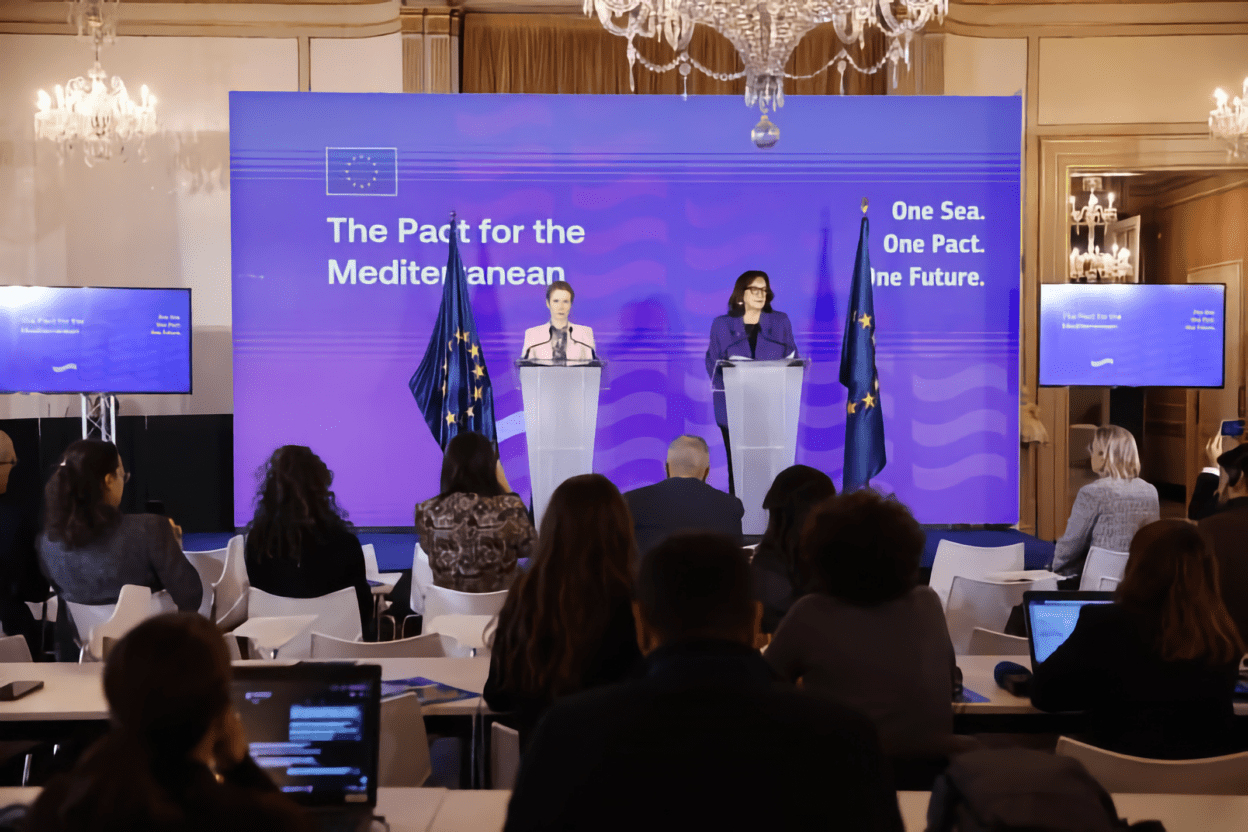
The European Union recognizes this reality and presented the Pact for the Mediterranean in an event held in Barcelona on November 28 , coinciding exactly with the 30th anniversary of the founding Declaration of modern Euro-Mediterranean cooperation. The choice of Barcelona was not accidental: the city has been the symbolic home of Euro-Mediterranean cooperation since 1995 and hosts the permanent headquarters of the Union for the Mediterranean. This is why the Catalan capital has once again been the stage for the renewal of this strategic commitment. It was no longer about commemorating, but about an ambitious attempt to transform the Mediterranean into an area of shared prosperity in the era of the green transition, digitalization, and new migratory tensions.
The presentation event brought together ministers from the European Union and the Southern partner countries in Barcelona, within the framework of the X Regional Forum of the Union for the Mediterranean.
- The EU "continues to commit to the Mediterranean" as a priority area for cooperation. This was summarized by the High Representative of the Union for Foreign Affairs and Vice-President of the European Commission, Kaja Kallas: "The geopolitical importance of the Mediterranean can never be overstated. The region connects three continents and serves as a bridge to the European Union for important exchanges between people, our economies, and security. With the new Pact for the Mediterranean, we are opening a new chapter and an opportunity for more productive cooperation and lasting stability in the region."
With this Pact, the EU is not just commemorating 30 years of the Barcelona Declaration; it is trying to update it for the era of the green transition, digitalization, and the blue economy, and to turn the Mediterranean—this historic bridge of cultures, economies, and routes—into a truly shared space governed in a more coordinated manner.
The Barcelona Declaration of 1995: the origin of Euro-Mediterranean cooperation
In 1995, the EU and 12 countries from the Southern and Eastern Mediterranean signed the Barcelona Declaration. This text is important because it is the first time it was openly stated: "we want a stable, prosperous, and shared Euro-Mediterranean region." And it was done with a very broad perspective: political (peace and stability), economic (area of shared prosperity), and human (dialogue between cultures).
The underlying idea was already very relevant: the Mediterranean is too small for everyone to go their own way. If we don't cooperate, the problems (migration, pollution, trafficking, tensions) become everyone's problems.
New Agenda for the Mediterranean (2021): Strategy update
In 2021, the European Union conducted a kind of "25-year review" and confirmed that the Mediterranean context had changed (Arab Springs, more migratory pressure, climate crisis, new geopolitical actors). For this reason, it presented the New Agenda for the Mediterranean and the Economic and Investment Plan for the Southern Neighbourhood. It is, in essence, a reaffirmation of the 1995 proposal, but updated.
What did that 2021 agenda seek?
- To relaunch the partnership with the southern neighboring countries, not just as a policy, but as a strategic relationship.
- To deepen cooperation in five key areas: human development and employment (especially youth employment), good governance and rights, resilience and crisis preparedness (including pandemics), climate action and green transition, and inclusive economic growth that does not leave behind SMEs and the local economy.
- To back it with real money: the Economic and Investment Plan envisioned mobilizing up to tens of billions of euros in investments for the region, with a focus on the twin green and digital transition, job creation, and providing opportunities for young people.
In that agenda, it was also established that cooperation with the South is not only about economics: the EU included dimensions of health (the root of COVID-19), security and defense, and a broader reflection on the southern neighborhood as a political and strategic space, not just as a recipient of aid. That is to say: in 2021 the EU already stated that the Mediterranean should be a space where migration, energy, maritime security, and climate resilience are discussed within the same framework.
1. People as the driving force for change
The Pact places people at the center and understands that, if talent is not nurtured, the rest remains on autopilot. For this reason, it is committed to strengthening higher education and vocational training, improving job opportunities, and giving more voice to youth and civil society. Projects such as the future Mediterranean University aim to make it easier for a student from Rabat to complete a stay in Barcelona or for a researcher from Athens to collaborate with a team in Marseille without as many administrative obstacles.
At the same time, the Pact wants culture, tourism, and sport to be a space for cohesion and not just a tourist attraction: protecting heritage, diversifying the offer, and making it more sustainable. And, fundamentally, there is a clear idea: without the empowerment of women and local communities, change remains incomplete.
This pillar focuses specifically on:
- Boosting higher education, skills, research, and innovation
- Reducing the skills and qualification gap in labor markets Euro-Mediterranean initiative for culture, sport, and tourism
- Empowerment of civil society, youth, and local communities
2. A stronger, greener, and connected Mediterranean economy
The second pillar aims for the Mediterranean economy to be more competitive, but also cleaner and more resilient. This involves modernizing trade and investments, making it easier for companies to work on a regional scale, and, above all, accelerating the transition towards clean energy and technology. The T-MED initiative, for example, seeks to ensure that renewable production and low-emission technologies do not remain dispersed pilot projects, but instead generate a scale effect throughout the basin.
In parallel, the Pact aims to strengthen the entrepreneurial ecosystem with instruments such as StartUp4Med or the Tech Business Offer, so that technological and data startups can grow without necessarily having to leave the Mediterranean. The port, in this context, ceases to be merely a logistical infrastructure and becomes an innovation platform: a space for testing, data, and new services.
This pillar includes, among others, the following lines of action:
- Modernization and strengthening of trade and investment relations for more inclusive and sustainable growth
- Creation of a regional support mechanism for startups (StartUp4Med)
- Promotion of more integrated digital and data economies (launching the Tech Business Offer)
- Trans-Mediterranean Renewable Energy and Clean Technology Initiative (T-MED)
- Partnerships for clean transition, sustainable growth, and resilience
- Reinforcement of a healthy and prosperous Blue Mediterranean
- More sustainable transport for a better-connected region
- Knowledge and statistics sharing to improve decision-making
3. Shared security and migration management
The third pillar addresses issues that often only appear in crisis headlines: security, emergencies, and migration. The Pact proposes better preparing the region for disasters (from floods to extreme heat events), improving coordination between countries, and establishing stable cooperation mechanisms. It is not just about reacting, but about planning.
In migration matters, the focus is on a "full route" approach: from the country of origin to the destination, passing through maritime and land routes. This implies working on visa policies, protection of rights, legal pathways, and the fight against trafficking networks, with more police and border cooperation, but also with more spaces for dialogue.
This pillar is defined by three main lines of action:
- EU-Med Peace and Security Initiative as a stable forum to jointly address these issues
- Greater preparedness and coordinated disaster response in the Mediterranean
- Implementation of a "full route" migration management approach
Implementation challenges: from words to actions
The New Pact for the Mediterranean and the Pact for the Oceans bring powerful words to the table: green transition, blue economy, youth, cooperation, shared security. But the real test will not be in the official documents, but in the sea. If a young person does not see more training and employment opportunities, if a marine energy startup does not find concrete instruments to scale projects across the entire basin, or if a port does not have clear tools to decarbonize its operations, the Pact runs the risk of remaining rhetoric.
Related posts
![Five years of Nexigen: innovation, sustainability and international leadership at the Port of Barcelona]()