
Wastewater and CO2 to produce marine e-fuel: how the SUPORT project works
The SUPORT project has demonstrated at laboratory scale that it is possible to produce synthetic marine fuel (e-fuel or e-diesel) from wastewater and captured CO₂. Led by the Institut de Recerca d'Energia de Catalunya (IREC), with the participation of the Port of Barcelona, the fuel obtained is compatible with conventional diesel engines without modifications, which could accelerate the decarbonisation of maritime transport and foster a circular port economy.
WHAT IS THE SUPORT PROJECT AND WHAT HAS IT DEMONSTRATED?
The decarbonisation of maritime transport is one of the great challenges of the energy transition. To achieve it, the development of sustainable fuels capable of replacing current ones has become one of the main lines of research.
In this context, SUPORT (CO2 Capture and valorization for the development of a SUstainable route to produce synthetic green fuels for maritime transport) emerges as a project exploring how to produce zero-emission synthetic fuels, or e-fuels, from resources that already exist in the urban and industrial environment (and are generally considered waste): wastewater and carbon dioxide (CO₂).
- After three years of research, the team has concluded that it is viable to obtain a synthetic fuel from wastewater and CO₂ at laboratory scale. Moreover, the e-fuel developed can be partially blended with or fully replace conventional fuels, meaning it could be used without modifying current engines or changing the supply chain. This makes it possible to reduce emissions linked to maritime transport and the port environment while adding value to CO₂ capture and wastewater reuse, fostering the circular economy.
"There is a clear need, a willingness, and also a regulatory push to decarbonise the maritime sector. We need to find an alternative, and what we propose is generating a diesel similar or identical to fossil-derived diesel, but using CO₂ in a way that would allow us to reach net zero emissions," Marc Torrell, senior researcher at IREC and coordinator of the SUPORT project, explains to PierNext.
"Furthermore, the synthetic fuel we have developed is compatible with current combustion engines, or would work with minor modifications far smaller than those required by other options such as methanol or ammonia, which do involve modifying vessels or at least their powertrain. These infrastructure changes are one of the things slowing down and complicating the decarbonisation of the sector," the IREC researcher adds.
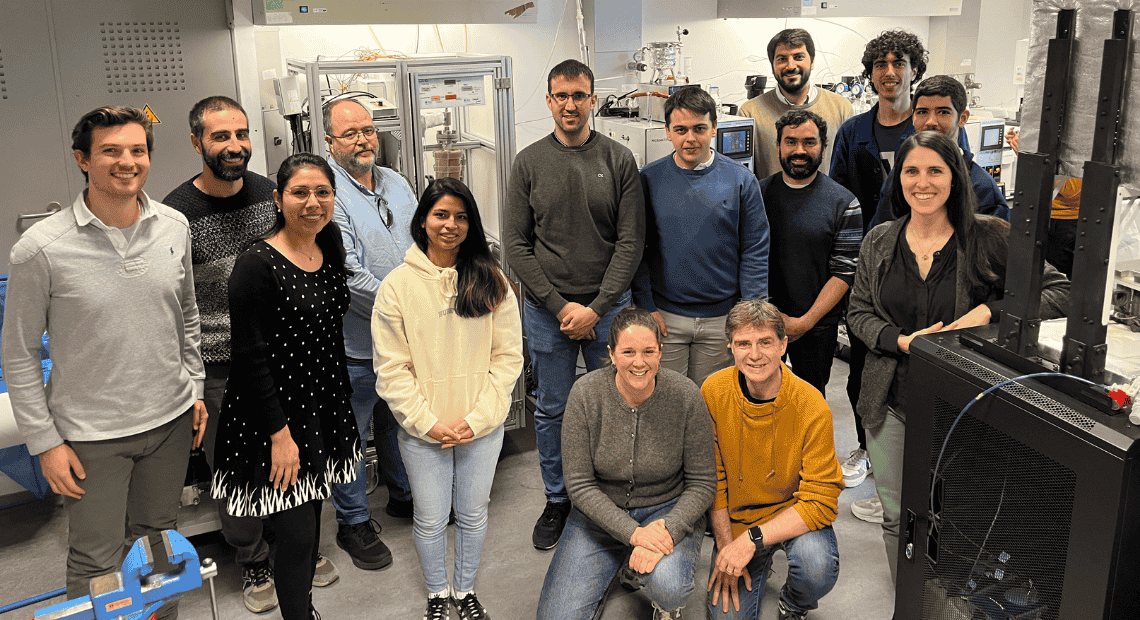
The project began in December 2022, led by the Institut de Recerca de Energia de Catalunya (IREC), with the participation of the Port of Barcelona, Aigües de Barcelona, Cetaqua, and the International Centre for Numerical Methods in Engineering (CIMNE).
"The synthetic fuel we have developed is compatible with current combustion engines, or would work with minor modifications far smaller than those that other options such as methanol or ammonia would require, which do involve modifying vessels or at least their powertrain."
Marc Torrell, senior researcher at IREC and coordinator of the SUPORT project
HOW THE E-FUEL PRODUCTION PROCESS WORKS: CO-ELECTROLYSIS AND FISCHER-TROPSCH
The e-fuel development process integrates two in-house developments from IREC:
- one linked to hydrogen and electrolysis technologies
- and another focused on catalysis, specifically the Fischer-Tropsch catalytic reaction.
In the first stage, a co-electrolysis step converts CO₂ and regenerated wastewater into a gas composed of carbon monoxide and hydrogen. The catalytic reaction then combines the hydrogen molecules with the carbon monoxide molecules to generate a synthetic fuel.
"We have brought together the developments of the last 12 to 15 years from both research groups. We like this scheme where we join the two parts together like Lego pieces to make synthetic fuel a reality," Torrell explains. The next challenge is to scale this technology to an industrial level in order to expand the offering of zero-emission fuels.
WHAT OTHER PROJECTS PRODUCE E-FUEL CIRCULARLY AROUND THE WORLD?
The global landscape of zero-emission synthetic fuels for maritime transport is today a territory in full ferment, with dozens of initiatives underway across Europe, Asia, and North America. The two most similar to what SUPORT has achieved are the following:
- The MegaSyn project, funded by the EU's Horizon 2020 programme through the Clean Hydrogen Partnership, shares with SUPORT the same core technology: the co-electrolysis of CO₂ and water using solid oxide electrolysis cells (SOEC) to produce syngas (a mixture of carbon monoxide and hydrogen). Its goal is to scale that technology to megawatt level in a real industrial setting —the OMV refinery in Schwechat (Austria)— where a system designed by the company Sunfire, under the coordination of the Technical University of Denmark (DTU), demonstrated the production of more than 900 tonnes of syngas from renewable energy. MegaSyn takes the technology shared with SUPORT a step further in scale; SUPORT, in contrast, goes a step further in the circuit: it adds Fischer-Tropsch synthesis to convert that syngas into liquid marine fuel, and does so using wastewater and CO₂ captured in situ within the port environment itself as raw materials — not waste from an industrial refinery.
- The most advanced example at commercial scale is the Kassø PtX plant by Danish company European Energy, inaugurated in 2025 as the world's first facility to produce e-methanol at industrial scale from renewable energy and biogenic CO₂. It already supplies vessels operated by Maersk and follows a circular logic —the CO₂ comes from agricultural residues— but the circuit is not local to a port: the CO₂ source, the production plant, and the vessels consuming the fuel are all in different locations. In addition, the methanol it produces requires adapting vessel engines, unlike SUPORT's e-diesel, which works in current engines without modifications.
- IREC has another project along the same lines: COMECOCO2 (Efficient production of green fuel for marine transportation through co-electrolysis of CO2 captured in wastewater treatment plants), active since 2025 with a horizon through 2028. Funded by the Spanish Ministry of Science, Innovation and Universities and the ERDF through the TRANSMISIONES 2024 programme, the project goes a step further and aims to validate a renewable methanol production system based on high-temperature co-electrolysis, with technology manufactured entirely in Spain. COMECOCO2 is led by IREC together with ViverCleanTech, with the Port of Barcelona, Moeve, and SYMNAVAL as members of the external advisory board.
THE CIRCULARITY OF A PROJECT: THE PORT, WATER TREATMENT PLANTS, AND THE RESEARCH CENTRE
A key aspect of the SUPORT project is the in-situ valorisation of CO₂ at the Port of Barcelona. Its objectives involve capturing CO₂ from the port's water treatment plant to produce fuel suitable for vessels and machinery. "This allows us to obtain a sustainable fuel based on the circular economy and zero-kilometre principles," explains Daniel Ruiz, Technical Manager for Sustainable Fuels at the Port of Barcelona.
"In the port's surroundings there is the Baix Llobregat wastewater treatment plant, run by Aigües de Barcelona, which could contribute its organic matter, regenerated water, or the CO₂ from its anaerobic digestion. At the port we could also eventually have sources of biogenic CO₂ — for example, from a possible biomethane production plant. And finally, to close the circle, the sustainable fuel could be used within the port itself. It would fit any diesel engine, both for land and marine transport, or in heavy terminal machinery such as reach stackers or straddle carriers," Ruiz explains.
For the IREC researchers, the port environment was key to conducting their research and developing their fuel. "The value lies in the fact that if a single water purification plant already provides the two inputs you need — water and CO₂ — everything becomes much simpler. Add to that the ability to investigate what water quality to use in order to reduce the cost of these raw materials, and the opportunities multiply. Everything revolves around a value chain present in Barcelona: we have the port, the water purification plants, and the research centre. It is a project framework we are very comfortable with, and one that has significant social impact because it seeks to improve the city."
THE PORT OF BARCELONA: A KEY SETTING FOR DEVELOPING ALTERNATIVE PORT FUELS
The project also aligns with the Port of Barcelona's Energy Transition Plan, which sets out a roadmap to progressively reduce the carbon footprint of port activities and associated transport, and to promote the use of alternative fuels. "We want to produce fuels, not just import them. Although scaling up the production of the e-diesel fuel from the SUPORT project has not been considered, the Port of Barcelona is planning the implementation of methanol or biomethane production plants," Ruiz explains.
"Space is being reserved at the Moll de l'Energia for the possible installation of a methanol production plant, which would be fed with biogenic CO₂ produced in the vicinity of the port. We are also studying the feasibility and best technology for installing a biomethane production plant within the port facilities, fed with MARPOL waste from vessels — mainly cruise ships — and from nearby organic matter sources such as central markets or selective waste collection," adds the Port of Barcelona's Technical Manager for Sustainable Fuels.
In this way, the Port of Barcelona presents itself as an ideal setting for developing projects like SUPORT, both for the technical support it provides and for the presence of real infrastructure and operational environments in which to research and test new fuels. "Having the Port involved adds an intangible value," Torrell adds. "I believe ports will be the main adoption points for new technologies in general."