

Five years of Nexigen: innovation, sustainability and international leadership at the Port of Barcelona
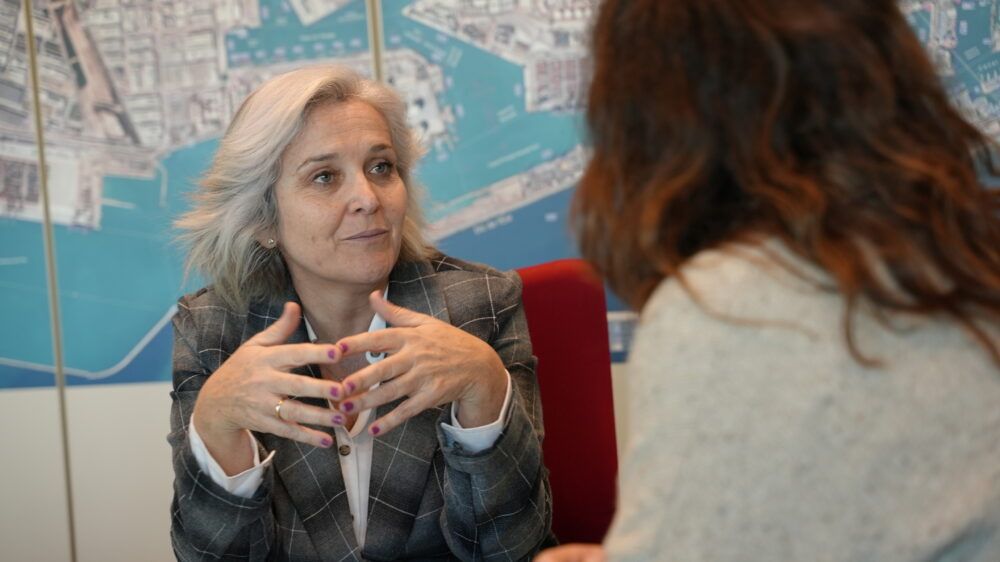
The Nexigen project at the Port of Barcelona continues to advance rapidly. With two terminals, BEST and Grimaldi, already supplying renewable electricity to container ships and ferries, a third terminal for cruise ships will be added in 2026. To gain an in-depth understanding of the current state of the Onshore Power Supply (OPS) project and the next steps to achieve the targets set for 2030 and 2050, we interview Ana Arévalo, head of the Shorepower department at the Port of Barcelona.
Posted on
12.16.2025
Being a completely new scenario for us, it has been a year of learning and optimization of technical procedures to adjust them to daily operations.
To give an example, when we started connecting vessels, we had a team of four people to carry out the connection and disconnection procedure. Today, we have reduced connection times and have been able to operate with just two people.
Another example: every time a vessel is connected we must notify all agents involved for security and operational reasons. At first we sent these emails manually, which meant being aware of connections at any time of day. Currently, we read the signal sent by the system automatically and it is replicated to all agents who need to know the vessel's status, which has allowed us to streamline and further secure the process.
These are just some examples of the improvements we have been implementing, but the truth is that we keep advancing and optimizing all processes.
It is worth highlighting the crucial collaboration with Hutchison Ports BEST, which from the beginning has understood the project and we have worked together to make it a reality. And today, to be able to connect ships at their terminal, they continue to play a very important role. So far, we have connected ships from shipping lines such as MSC, ONE and CMA and we trust that in the second year of the pilot we can add many others. In summary, it has been a very positive first year.

[P] From September 2024, the forecast was to make one connection per week to reach 40 in the first year. Have these figures been met?
[AA] If we look at the number of calls, in this first year of operations we have been able to connect 30 vessels. However, it is necessary to look at all the figures and interpret them jointly and not in isolation since, during this first year, the operational and energy impact has been much greater than what we had initially projected, despite the number of calls being lower than expected.
And this has an explanation: when we made our initial estimates, we started from the hypothesis that most calls would correspond to vessels of around 300 meters in length, with connection times and energy consumption lower than what we encountered.
We faced a very different reality. Most of the ships we have connected are 24,000 TEU container ships, that is, much larger, with lengths of around 400 meters. This implies average consumption of around 98,000 kWh per call and significantly longer port stays.
The average connection time is around 63 hours, and, in fact, we have achieved a European record by keeping a container ship connected for 91.3 hours in a single call.
Therefore, fewer calls, but more time, more energy and greater emission savings than initially expected. So we are satisfied.

[P] And what do shipowners and shipping lines tell you about their experience?
[AA] Here too there has been a learning process for both parties. Let's keep in mind that, for shipowners, all this is also very new, so communication and joint work are fundamental. The pilots we carry out have, among other purposes, that shipping lines can verify that their system works correctly and evaluate operations under real conditions. For shipowners, being able to connect and help us adjust processes is important because it prepares them for when this connection is mandatory, without forgetting that it is mainly about reducing emissions when they are in port.
[P] You mentioned the word pilot. Are tests continuing at the BEST terminal?
[AA] The infrastructure at the BEST terminal is completely finished and we are now in a very interesting phase, since during the first year we established KPIs and have been collecting a set of data that, during this second year, we will continue to collect. We are going to analyze them, and this will allow us to continue optimizing specific situations and improve operations.
[P] In March 2025, the OPS was connected at the ferry terminal on Sant Bertran dock. What similarities and differences exist with the BEST terminal?
[AA] The most relevant aspect of Grimaldi's ferry terminal is its location very close to the heart of Barcelona. This translates into a significant reduction in emissions and noise for the neighborhoods near the dock, improving the quality of life for residents.
At the infrastructure level, we can say that the principle is the same and the technical differences are established by equipment sizing and voltage differences. That is, on one hand, the power consumed by container ships and ferries is different. In one case they are connecting at 6.6KV and in the other, at 11kV.
Although, without a doubt, the most important differentiating element is the way of connecting.
In the case of container ships, they carry the cable on board and they are the ones who throw it to the dock and it is the shore team that makes the connection. In the case of ferry vessels, the CMS (cable management system) acts like a crane and not only connects, but also raises the cable to the vessel's hatch, where it is collected by the crew and also connected by them.
Also at the operational level, the terminal presents clear differences compared to BEST. At Sant Bertran, ferries make daily routes to and from the Balearic Islands following a fixed schedule, while at BEST the container ship operation is much less regular and continuous adaptation to variations is necessary.
At the Grimaldi terminal, since March, we have been able to connect almost 150 calls, with a weekly average of around four and a half hours of connection, which has meant avoiding the emission of some 325 tons of CO₂. Our challenge here is to increase the time these ships are connected, which is currently around 75% of the time they remain docked, to maximize emission savings and improve onboard comfort thanks to the reduction of vibrations and noise.
In summary, technically the OPS we install are similar in terms of transformers, frequency converters, etc., but each type of vessel has its own characteristics, connection times and different energy consumption. And operations must be adapted to them.
[P] Have you leveraged the learning acquired at Hutchison Ports BEST to optimize the installation and operations?
[AA] Absolutely. The BEST project has served us as a reference and source of learning. From it, we have extracted what I like to call "lessons learned," which we have adapted and transferred to the ferry project and which we will continue to perfect in future cruise projects and in the rest of the OPS we deploy.
Broadly speaking, we could say that in a project with these characteristics there are 4 differentiated phases: planning, design, construction and operation. In the planning phase, it is very important to take into account what the operation of each terminal is like and what space is available, although there are base parameters that can be replicated and optimized.
In the design phase, not only are factors such as physical space and operations that must coexist crucial, but above all whether the terminal is operational or not. For example, at BEST the installation was built in an area that was not in operation, while at the ferry terminal the construction was coordinated with the terminal's operations. This forces us to adapt and anticipate what will happen when integrating the different parts of the OPS.
Finally, in operations there are actions that are repeated, although they are not identical, since each terminal has its own particularities. But it is always easier to do something if you have done it before, such as defining connection and disconnection procedures, coordinating with all parties involved, defining applicable tariffs or monitoring calls remotely, among many other things.

[P] How has the collaboration with Grimaldi gone?
[AA] Both with BEST and with Grimaldi, the collaboration has been fantastic. In Grimaldi's case, they have acted on two fronts, as a terminal and as a shipping line (Trasmed). In this case, the fundamental difference with the container terminal is that there was no fleet prepared to connect, so it was necessary to have the commitment of some shipowner so that, once the infrastructure was completed, the OPS could be connected.
In this sense, Grimaldi has supported us unconditionally from the moment the project was proposed. Our OPS was ready at the same time they completed the retrofit of the Ciudad de Palma vessel, so when everything was ready, we were able to start connecting the calls when this ship was in Barcelona. Here the involvement of the crew has been vital, who have been aware of the importance of knowing how to operate these systems. Currently, in addition to the Ciudad de Palma, Trasmed is also preparing the Ciudad de Sóller and the Ciudad de Barcelona so they can connect to the OPS.
In the short term, our intention is to gradually incorporate all OPS-ready vessels to these connections. This is especially relevant, because the final objective is that all ships that dock at the terminal operate either with batteries, since Grimaldi already has some vessels of this type, or connect to the OPS, so that the Sant Bertran dock becomes a zero-emission installation.
In summary, the collaboration with Grimaldi has been absolutely indispensable. In fact, I know that they are also very satisfied with how the project is progressing, as it is a company that has long been committed to sustainability in all its operations.
[P] The current system connects a single ship, but the installation has been designed so it can be expanded to two ships simultaneously. Why wasn't this done from the beginning?
[AA] This is one of my lessons learned. When we designed the OPS, the most important thing was to have electrical power and in the Grimaldi OPS area we only had 2.5 megawatts. In 2021 we had collected information on the power consumed by ferries coming to Barcelona, which were in the order of 2.2 or 2.3 megawatts. We opted to be conservative because it didn't make much sense to make an installation for two ships when we really only had power for one.
However, when we set up the system we prepared it to be able to duplicate it, which means leaving it ready to place one and a half more containers, with transformers, frequency converters, etc., and configure it for when we have more power in the future.
What has been the result of the pilot after more than 100 calls? That the ship we are connecting is not consuming as much as we had anticipated. That's why we are working on the specifications to duplicate the system and, with those 2.5 megawatts and perhaps with some intermediate battery, adapt it to be able to connect two ships at the same time.
At this point I always emphasize the importance of having reliable data to make designs. There are many decisions that are made based on existing data and, for some reason, actual vessel power data is not available, which can lead both extremes to over-dimension installations. It is critical that a reliable public database exists on the actual consumption of vessels.

[P] This installation completes the first phase of the Nexigen plan. How many remain and what do they consist of?
[AA] Phase zero, corresponding to the construction of the OPS infrastructure for BEST and Ferries, is now complete, and we are currently developing phase one, which consists of the construction of the electrical substation, scheduled to be completed in the first part of 2027. This first phase also includes the medium voltage line that connects the substation with the Adossat dock.
In parallel, the cruise OPS project at the MSC terminal has been awarded, construction of which will begin in January 2026, and the Royal Caribbean project, which is expected to be awarded in the first quarter of next year. This means that next year three works will coincide simultaneously: the Port substation and the cruise OPS at the MSC and Royal Caribbean terminals.
Phase two will cover the rest of the Adossat dock, including the current terminals A, B and C, as well as Carnival. In the next two or three years, the entire northern part of these terminals will be transformed into the new terminal C, going from three terminals to a single one, and incorporating the electrification of all its docks.
From the Port Substation, medium voltage lines will be deployed to distribute renewable electricity to all docks and thus be able to build and power the OPS.
The final phases will allow compliance with the target set by Europe for 2030: to have OPS at cruise, container and ferry docks, supplying energy to at least 90% of the calls at all these terminals. Subsequently, car terminals will be electrified and, in the final phase, liquid and solid bulk terminals, with the objective that the entire port achieves total electrification by 2050.
[P] Today, how many European ports have OPS installations and operations comparable to those in Barcelona?
[AA] Currently, both in Europe and in the rest of the world, progress is being made in the development of OPS installations. We participate in several working groups and maintain close contact with colleagues from other ports who are carrying out similar projects. These meetings are very valuable, as they allow us to exchange technical information and share lessons learned. Despite the differences between ports, we are all working with the same technology and we face very similar challenges.
To mention some examples, Hamburg inaugurated its OPS for container ships a little before us and Rotterdam and Le Havre have an OPS for cruise ships. The ports of China are also very active, where numerous projects of this type are being developed. The construction of these systems will become increasingly common. We have the 2030 horizon and we know that electrifying ports is not an easy task.

[P] You highlighted that it is interesting to meet with other ports to share experiences. Why is it important?
[AA]In the development of such innovative projects it is fundamental, to replicate what works well and avoid mistakes that others have already experienced. In the same way that we have been learning first from others and then from our own experience, it is in the DNA of the Port of Barcelona to share that learning. That's why we have organized several visits to our OPS, to be able to share the experience with other ports. This year, we have organized a visit aimed at disseminating knowledge to the rest of the Spanish port authorities during SIL and we have also received visits from groups of experts at an international level with whom we work in the OPS groups of IAPH and PIANC.
[P] PIANC will include the Port of Barcelona's Nexigen Plan in its guide to international references for OPS installation. How do you value this recognition?
[AA] The Port of Barcelona has established itself as a pioneer in docks electrification and Nexigen is already a recognized reference at European and even global level. All this work has been developed in a very short period of time, which demonstrates the intensity and agility of the process. I like to compare it to the operation of a startup, because we really started from scratch and had to innovate, adapt and advance rapidly to achieve the objectives.
PIANC has recognized this effort by including our experience in the guide it is preparing for the global implementation of OPS systems. This guide collects learnings from all members of its OPS group so that ports that initiate or develop these systems can do so more efficiently.
[P] What reflections do you want to share after five years since the birth of Nexigen?
[AA] After five years since the birth of Nexigen, we are in a maturation phase. We have gone from defining the vision and laying the foundations to being clear about what we must do and how to carry it out. This point invites us to reflect not only on technical execution, but also on how we want to manage OPS systems in the future. The key question now is: how to ensure that this transformation is sustainable in the long term?
The business model presents itself as one of the greatest challenges. Docks electrification involves very significant investments and, for deployment to be viable, we need to explore new financing and governance structures. This challenge is not exclusive to the Port of Barcelona; it is common in many European ports that seek to accelerate implementation to meet the decarbonization objectives of the Fit for 55 package without compromising their financial stability.
In this context, we are analyzing innovative formulas, such as the creation of a public-private partnership to lead the execution of the Nexigen Plan. This model would allow sharing risks, attracting investment, guaranteeing operational efficiency and, above all, consolidating a stable framework for OPS management. The magnitude of the investment and the climate urgency force us to think about collaborative solutions that ensure that the energy transition is not only fast, but also sustainable and competitive.
In short, the reflection after this five-year period is clear: electrification is no longer an option, it is a necessity. The challenge, now, is to turn it into an economically viable and operationally efficient reality, and for this we must innovate not only in technology, but also in business models.

Related posts
![The new Pact for the Mediterranean 2025: the EU renews Euro-Mediterranean cooperation 30 years after the Barcelona Process]()