
Welcome to the future: the opinion of CEOs from four cutting-edge ports
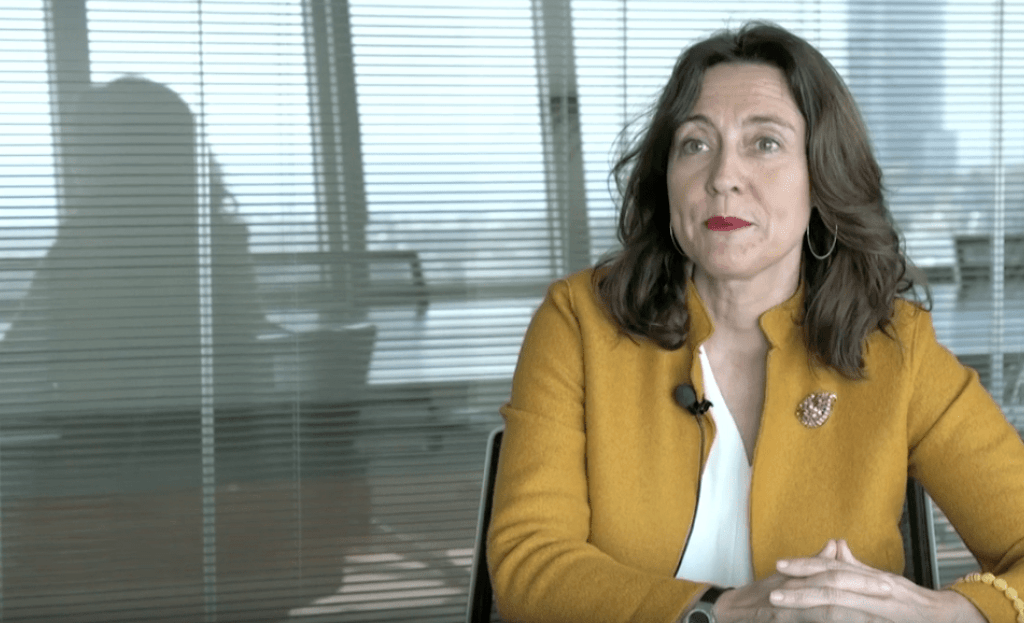
- [On-screen text]: #TECHNOLOGY - Smartports: sailing towards efficiency and sustainability.
- Speaker 1 (Jens Meier, CEO at Hamburg Port Authority): "There's an enorme opportunity to increase the efficiency in ports and logistics supply chains or demand chains."
- Speaker 2 (Mercè Conesa, President of Port de Barcelona): "The main trends that will impact ports in upcoming years will be technology, innovation, and climate change. Here, in Port of Barcelona, we are investing 10 million euros to develop a new telecommunication network to work in the near future with a 5G system."
- Speaker 3 (Gene Seroka, Executive Director of Port of Los Angeles): "In the area of technology, we see the work being done right now on digitization of the data in the supply chain to be very important. That work, along with our Chainport partners, is realizing how we can share information and make for a more smooth conveyance of the goods that we ship between our ports and to our customers."
- Speaker 4 (Sylvie Vachon, President & CEO at Port of Montreal): "We will see the trend of diversification of port authorities into value-added logistics processing. The Port of Montreal, as an example, operates its own railway. The Port of Antwerp manages ports in Africa and Brazil. The ports of Rotterdam and Singapore manage Blockchain labs and 3D printing facilities."
- Jens Meier: "We are able to reduce empty and unnecessary transportation—empty trucks, empty containers on trucks—and also we can increase the efficiency by using the infrastructure in a more efficient way, that means higher utilization on trains and also higher utilization on roads."
- Mercè Conesa: "It will allow us to share vital information with our stakeholders, and at the same time we will improve our system and the port will have the opportunity to be vital in galvanizing the supply chain."
- [On-screen text]: Automation is leading to new modes of transportation, while digitalization will take over the maritime industry.
- Jens Meier: "The Port of Hamburg is always interested in new modes of transport, and that was also the reason why we visited Hyperloop together with our Chainport partners."
- Sylvie Vachon: "Another important trend is the digitization of the maritime industry. Data has become a source of competitiveness. Cyber resilience will likely change the way we think, and ports must assume there could be cyberattacks and be prepared."
- Jens Meier: "From my point of view, much more important is how to use things like autonomous driving and platooning for trucks; how can we use these kinds of trends to make ports and logistics supply chains more efficient."
- Sylvie Vachon: "Port authorities extend their reach into the entire supply chain and become digital facilitators."
- Jens Meier: "That is one of the reasons why we are testing the new 5G standard, 5G mobile network architecture standard in the Port of Hamburg: how can we use this new standard to ensure that autonomous driving is possible in ports."
- [On-screen text]: The main challenge though will be sustainability and the energy transition.
- Mercè Conesa: "In regard with sustainability, our main challenges are focusing our efforts to provide new technology systems with clean energy. Our challenge is to reduce pollutant emissions using solutions like LNG or hydrogen, and of course, fighting against climate change."
- Sylvie Vachon: "Public expectation towards environmental standards of large port projects will only grow. Ports, as guardians of public assets, must demonstrate best practices in the field of social acceptability, however there will be an increasing cost to bear."
- Gene Seroka: "Banding together with other ports, such as our member colleagues in Chainport, will give us a wider customer base to work with the OEMs on now and into the future, and hopefully bring that technology quicker to our port environment."
- Sylvie Vachon: "Ports must proactively manage an energy transition. Decarbonizing the supply chain will be a collective effort, but ports will have to introduce deeper and more systematic measures in the long term to transition smoothly toward emission-free objectives."
- [Visual outro]: Logos of Chainport and PierNext (Innovation by Port de Barcelona).