Capital sets sail: the next wave of blue economy investment


"If the blue economy were a country, it would be the world's seventh-largest economy by GDP," says Cláudia Rocha, PwC Partner and Leader of the Blue Economy Centre of Excellence (Blue Economy Barometer, PwC).
In the European Union alone, the blue economy already generates close to €891 billion in annual turnover, €251 billion in gross value added (GVA) and 4.82 million direct jobs (2022 data), according to the EU Blue Economy Report, published by the European Commission.
The figures show that blue economy investment has moved from promise to a market with its own dynamic, although still an uneven one. The BlueInvest Investor Report 2026: The Next Wave of Blue Growth, presented this March at the BlueInvest Day in Brussels, portrays an ecosystem where capital is already there, but where the pipeline of mature, scalable projects remains the main bottleneck. The study, prepared by PwC Luxembourg for DG MARE, is both a diagnosis and an agenda.
In short, there is more private capital than ever ready to enter the blue economy, but the supply of sufficiently "bankable" projects does not keep pace. This is why the report acts both as a market snapshot and as a call to action for Europe's financial ecosystem.
What BlueInvest is and why it matters to investors
Beyond publishing periodic reports, BlueInvest has become an innovation and investment platform for startups and SMEs in Europe's blue economy. With a community of more than 2,100 members across companies, investors and institutional stakeholders, it offers support services, investor matchmaking, training, pitch events and international visibility, always aligned with EU priorities on marine sustainability, decarbonisation and industrial competitiveness.
Since its launch, BlueInvest has supported more than 330 blue startups and scale-ups, engaged over 300 investors and helped mobilise more than €300 million of investment into the sector. Its associated fund, the BlueInvest Fund, managed by the European Investment Fund (EIF), provides capital specifically targeted at venture capital funds active in the blue economy.
The aim is, on the one hand, to give international visibility to Europe's blue companies; on the other, to facilitate deal flow so investors can find, compare and contact projects directly aligned with their investment thesis.


A market hungry for capital but short on "bankable" projects
The core conclusion of the BlueInvest Investor Report 2026 is that the main problem is no longer a lack of investor interest, but the ability to generate a sufficient flow of mature, scalable projects with clear returns. For funds, the blue economy is both an opportunity and a challenge: these are sectors with long cycles, high technological intensity and non-trivial regulatory and environmental risk.
The report identifies 159 private funds active in the EU's blue economy, with around €3 billion coming from funds fully dedicated to the sector and another €11 billion from investors with partial exposure. In total, some €14 billion of private capital is oriented towards this agenda.
The BlueInvest Barometer 2025, a survey of venture capital and private equity funds active in the blue economy, paints a market that is eager to grow but still very young. There are more funds willing to enter, but most are small or mid-sized and few are specialised in pure blue plays.
That does not stop expectations from running high. Investors are seeking strong returns and, above all, entering at early stages, where risk is higher but so is growth potential. In parallel, many of these funds combine financial criteria with environmental impact objectives, reinforcing the idea that blue is one of the major sustainable investment verticals.
When it comes to sectors, interest is concentrated mainly in shipping, shipbuilding, ports and marine renewables. Coastal tourism, by contrast, generates much less appetite, perceived as a mature, fragmented sector that is highly exposed to climate and regulatory risk.


Where blue investment is concentrating
The blue economy is not a single market but a mosaic of verticals with very different levels of maturity, risk and bankability. The BlueInvest Investor Report 2026 identifies six key sectors where investor interest is concentrating.
- Aquaculture and Fisheries. More than 223 million tonnes of global production and a direct sales value of around €403 billion, with aquaculture as the main growth engine.
- Blue Biotechnology. Blue biotech is presented as a cross-cutting vertical, with diverse value chains in play (food and feed, enzymes and biochemicals, materials, health, carbon capture). The real value often emerges when its products replace fossil-based or hard-to-scale ingredients in other industries.
- Blue Renewable Energy. Globally, offshore wind has reached around 83 GW of installed capacity, while the EU has set combined targets of roughly 88 GW by 2030 and around 360 GW by 2050. This positions the sea as a strategic pillar of Europe's energy transition.
- Blue Tech & Ocean Observation. This is the enabling sector: sensors, robotics, gliders, satellites, digital twins, AI and data platforms that turn ocean information into economic infrastructure — data-as-a-service for renewables, shipping, aquaculture, defence and cybersecurity.
- Shipping and Ports. This includes freight and passenger transport as well as all the infrastructure, terminals and services that make it possible. It is the most attractive sector to surveyed funds: 46% rank it as the one with greatest potential, ahead of marine renewables (41%), water management (38%) and blue biotechnology (36%).
- Water Management. It appears as a less mediatic but strategic and unavoidable market, driven by climate, urban and agricultural pressure. It covers the full chain: monitoring, smart networks, treatment, reuse and associated services.


Public policies that activate investment
The message from investors is not "give us more projects and that's it", but "help us turn cost and risk into an investment case". The report cites the example of water contracts: with very long tariff cycles and strict regulation, they are often only "bankable" in countries with well-defined, predictable frameworks.
When asked which public initiatives can mitigate the risk of blue investment, the results are clear:
- Grants and subsidies: 62% (most valued instrument).
- Blended finance (combining public and private capital): 41%.
- R&D support: 36%.
- Tax incentives, regulatory simplification and public-private partnerships (PPPs): 28% (each).
- Public procurement: 18%.
In parallel, many investors feel that the traditional financial system, especially banks, offers little dedicated support to the blue economy, both nationally and at European level. Hence the particular value they place on mixed instruments and on the presence of impact investors and specialised funds.
What funds expect over the next five years
If today's bottleneck is the shortage of bankable projects, what do funds expect over the medium term to unblock it? The BlueInvest Barometer 2025 sets out priorities and risks with concrete figures.
- Looking ahead, investors set out their priorities clearly: 74% of blue economy funds put "meeting return-on-investment (ROI) targets" as their top five-year priority, followed by increasing the number and quality of deals (47%) and raising new capital (40%).
- On the risk side, the first factor they flag is general economic uncertainty (70%), followed by the long investment horizons that many marine and coastal projects require (65%). Regulatory, political, environmental and technological risks also appear prominently, but in a second tier.
Ports as the key piece of the next blue wave
The blue economy is moving from being merely a sustainability agenda to becoming a real space for investment, reindustrialisation and applied innovation. The underlying message of the BlueInvest Investor Report 2026 is unequivocal: there is capital, there is an agenda and there is urgency — but project maturation needs to accelerate and public policies need to be better aligned with investors' real needs.
In this scenario, ports emerge as a central piece. They are no longer just gateways for goods, but platforms from which to accelerate electrification, test new fuels, deploy digital technologies and connect industry, logistics and transport in a low-emission framework.
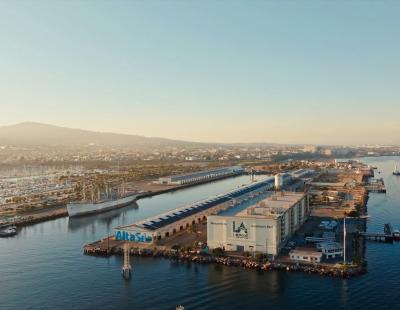
In this respect, initiatives such as the Port of Barcelona's BlueTechPort project make this acceleration possible, providing an ecosystem that drives and energises innovation. Put another way: for many investors, the port of the future is not only more efficient, but also smarter, more flexible and more open to innovation.
The key now will not just be to attract investment, but to turn scattered projects into solid, replicable, sufficiently mature cases that can attract capital. Because the next blue wave will not be played out only on the technological or financial front, but in the ability of ports — and their ecosystems — to become the engines of a new maritime economy.